—— GB39800.1-2020 Interpretation for National Standard for Specification Provision of Personal Protective Equipment – Part 1:General Requirement
【Abstract 】This paper briefly introduces the background of GB 39800.1-2020 “Specification for the provision of personal protective equipment -Part1:General requirement,as well as formulate the background.equipmentt principles,equipment procedures and equipment management of PPE,so as to provide technical support for the implementation of the standard.
【Keywords】specification for the provision; personal protective equipment;national standard; the basis for standard making·
0 Preface
According to the “Notice of the National Standards Committee on the Release of the Fourth Batch of National Standard Revision Plans in 2017” (National Standards Committee Comprehensive (2017) No. 128), the Beijing Institute of Labor Protection Science took the lead in drafting and formulating the national standard “Personal Protective Equipment Equipment”. Specifications (General Provisions)” (plan number: 20173391-Q-450). This task issued by the National Standardization Administration is to establish a project as a mandatory national standard. This standard project was proposed by the former State Administration of Work Safety and approved by the National Personal Protective Equipment The Standardization Technical Committee is in charge. In order to formulate this standard, as early as the second half of 2016, entrusted by the Policy and Regulation Department of the former State Administration of Work Safety, the National Personal Protective Equipment Standardization Technical Committee organized and carried out the equipment of personal protective equipment in some key industries. The main members of the standard compilation group also participated in the research work. The research group carried out work according to the target area, and successively went to PetroChina, Sinopec, Ansteel Group, CSIC, GAC Honda Automobile Co., Ltd., and SGS to pass the standard technology Service companies and other inspection and testing institutions conduct on-the-spot investigations. At the same time, a symposium will be held to invite relevant personnel such as enterprise management, safety supervisors, procurement personnel, front-line employees, personal protective equipment manufacturers, and testing and inspection units to participate in the discussion on personal protective equipment equipment, The problems and suggestions in the use, production and management were exchanged. Questionnaires were distributed to the personnel involved in the management, use and procurement of personal protective equipment in the enterprise to discuss the supervision, use and procurement of personal protective equipment by the enterprise and the existing Opinions and recommendations for protective equipment were investigated.
In December 2017, the standard preparation team completed the draft standard, and repeatedly solicited opinions from inspection and testing institutions, production enterprises and users in key industries such as petroleum, chemical, metallurgy and nonferrous metals. At the same time, the standards preparation team reviewed a large number of relevant materials on the management of personal protective equipment at home and abroad, and focused on the management of personal protective equipment in my country and the management of personal protective equipment in developed countries. Comparing the gap between my country and foreign developed countries in the field of equipment management, a standard discussion draft was finally formed in June 2018.
In the second half of 2018, under the leadership of the National Technical Committee for Standardization of Personal Protective Equipment, the standard compilation team conducted a survey of typical industries such as petroleum, chemical industry, metallurgy, and iron and steel on various types of work, hazardous and harmful factors of various types of work, and the equipment requirements for personal protective equipment for various types of work, etc. A more extensive and in-depth research work has been carried out. In the process of investigation, the standard was introduced, and the opinions and suggestions of the user units were further listened to, and the draft standard was improved. During this period, the standard compilation team solicited opinions and suggestions from various parties, including holding several seminars, and conducted in-depth communication with users such as PetroChina, Sinopec, CNOOC, Baosteel, and Southwest Aluminum. In January 2020, the “Personal Protective Equipment Specifications (General Provisions” (draft for comments) were completed.

1 Principles of personal protective equipment
The main object of the provision of personal protective equipment is the employer, so the provisions mentioned in the principles are all for the requirements of the employer. The standard is divided into 6 articles in the provisioning principle, which are:
1.1 When there are occupational hazard factors and hazard risks in the workplace, the employer shall equip the workers with personal protective equipment that conforms to national or industrial standards. This article clarifies the applicable conditions for the provision of personal protective equipment, and emphasizes the necessity of equipping workplaces with occupational hazards and hazard risks. ” fully reflected.
1.2 The personal protective equipment provided by the employer for the operating personnel shall be suitable for the environmental conditions, operating conditions, existing hazard factors and degree of hazard of the workplace, and shall be suitable for the operating personnel, and the personal protective equipment itself shall not cause other additional risk. This clause clarifies the suitability of protective equipment, and neither under-protection nor over-protection is recommended. Suitability is the best choice.
1.3 When the employer is equipped with personal protective equipment, it should take into account the comfort on the basis of ensuring effective protection. This article considers the requirements of protective equipment from the perspective of users, which reflects the humanization of protective equipment. On the premise of satisfying effective protection, other needs of users can also be considered. The comfort and aesthetics of protective equipment are also in the column.
1.4 When multiple personal protective equipment needs to be equipped at the same time, the compatibility and functional substitution of use should be considered to ensure effective protection. This article indicates that since the hazards and hazards in the workplace may coexist in a variety of ways, it is necessary to use a variety of protective equipment together or select equipment with multiple protective functions, which requires consideration of the compatibility of use and functional alternatives. .
1.5 Employers should equip and manage personal protective equipment for the temporary employees such as dispatched labor, accepted interns and other outsiders who are allowed to enter the workplace. This article clearly clarifies that the protection is for those who need protection, regardless of their identity, status or other, as long as they need protection, they should enjoy protection. The equipment and management of protective equipment is also obliged to implement the equipment and management of personal protective equipment for other personnel.
1.6 Employers shall, on the basis of this standard, carry out the allocation and management of personal protective equipment in combination with the national standards for personal protective equipment in their industry; when there is no national standard for personal protective equipment in the industry, the provision and management of personal protective equipment shall be carried out in accordance with the requirements of this standard. See Appendix A for the industry numbers and related numbers for PPE equipment. This article fully takes into account the breadth and complexity of the domestic industry, and different industry units can find corresponding protective equipment equipment and management plans.
2 Procedures for equipping personal protective equipment
The allocation procedure is the guarantee for the scientific and rational allocation of protective equipment. The standard provides the basic flow chart of the allocation of personal protective equipment, and highlights the identification and evaluation of hazard factors and the selection of equipment, two key links in the allocation process.
2.1 Flow chart of personal protective equipment allocation The allocation process starts from determining the scope of identification, identifying and evaluating the hazard factors, and in the case that the risks and hazards cannot be completely eliminated by taking engineering or management measures, the selection of personal protective equipment can be used to realize the protection of operators. The whole life cycle management of protective equipment is completed through the procurement of protective equipment, warehousing acceptance, issuance, training, and use, and finally to the preservation, maintenance, inspection and scrapping of protective equipment
2.2 Identification and Evaluation of Hazardous Factors
2.2.1 Identification of Hazardous Factors
The identification of hazard factors must be done in accordance with laws and regulations, with reference to standards and the use of professional knowledge to identify possible hazard factors according to the characteristics of different workplaces, production processes, and operating environments. It is necessary to systematically analyze various factors in production and operation activities, including personnel, equipment and facilities, materials used, process methods, environmental conditions, and management systems. It includes analyzing the hazard factors existing in normal production operations, as well as analyzing the hazard factors that may occur under abnormal circumstances such as changes in technology, materials, and processes, equipment failure or failure, and personnel operating errors. Hazardous factors in the operating environment should be analyzed by means of on-site investigation, measurement, review of relevant records, safety checklists, inquiries and exchanges. From theoretical guidance to practical operation methods, it provides a scientific and comprehensive solution for the identification of hazard factors.
2.2.2 Assessment of Hazardous Factors
For the assessment of hazard factors, professionals should evaluate the identified hazard factors according to national regulations, standards, etc., to determine the location of hazard factors, the way of hazard, the time and way of hazard occurrence, and the possibility of harm to human body. , extent and consequences. Employers can conduct self-assessment in accordance with national laws, regulations and standards, or entrust qualified third-party institutions to conduct assessments. selection provides the correct information.
2.3 Selection of personal protective equipment
After completing the identification of the hazard factors in the workplace and obtaining the results of the hazard assessment, the employer needs to select the appropriate personal protective equipment in combination with the protective position, protective function, scope of application and suitability of the protective equipment to the user.
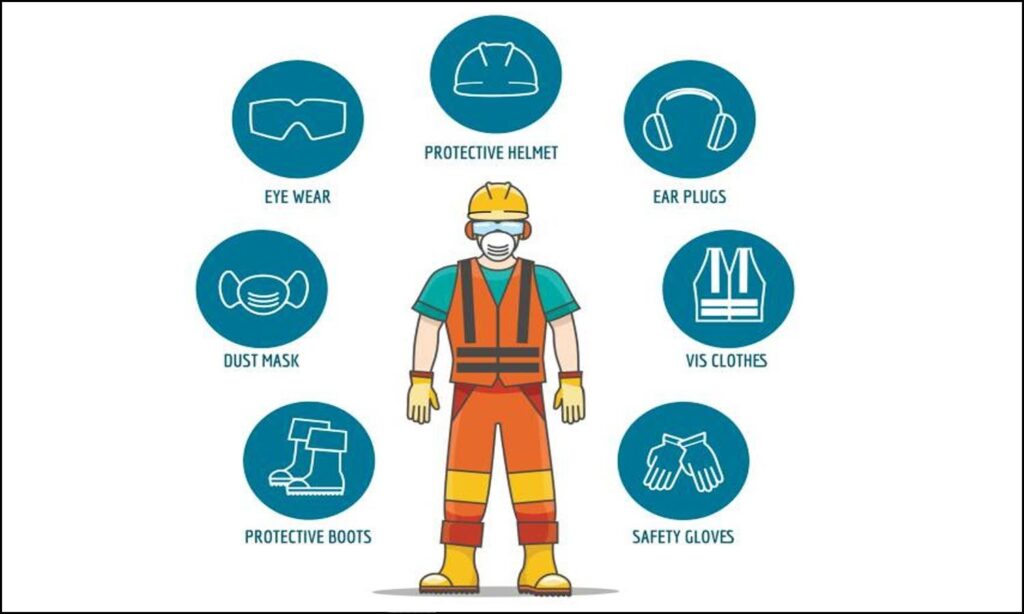
The standard divides personal protective equipment into 8 categories and 49 subcategories, including head protection, eye and face protection, hearing protection, respiratory protection, protective clothing, hand protection, foot protection, and fall protection. These protective equipment all have different protective functions, meet the requirements of national or industry standards, and can resist the corresponding hazard risks.
3 Management of personal protective equipment
The management of personal protective equipment equipment is the key to whether this standard can be implemented in place. Comprehensive training and education for users of the equipment to achieve “use, use, and use” protective equipment, and ultimately achieve good protection. 3.1 Basic requirements
The article clearly states that employers must establish a sound personal protective equipment management system, at least including procurement, acceptance, storage, selection, distribution, use, scrapping, training, etc., and establish and improve personal protective equipment management files. Special instructions are made on the purchase and acceptance of protective equipment, whether the products meet national or industry standards, and the protective equipment for regular compulsory inspection.
3.2 Traceability
The construction of the traceability system is an effective measure to collect and record the information of product production, circulation, consumption and other links, to achieve the goals of traceable source and traceable destination, and to strengthen the quality and safety management and risk control of the whole process. By assigning a tracking and traceability mark on the smallest coded packaging of the product, the information of the mark is entered into the national tracking and traceability system platform by the manufacturer, etc., and the employer can pass the tracking and traceability mark when purchasing, warehousing acceptance, and issuing protective equipment for use. Get valuable information. By tracking the traceability logo, it can be determined whether the product meets the national or industry standards, whether there is a report issued by an inspection and testing agency with testing qualifications, whether it is in a batch quality control state, whether it is produced by the original factory, and whether there may be circulation information, etc. . The use of this traceability logo can maximize the guarantee that the products purchased by the employer are authentic and avoid buying counterfeit products; at the same time, manufacturers can also use this traceability logo to improve the anti-counterfeiting of products and avoid illegal merchants. counterfeit.
3.3 Judgment and replacement
The standard clarifies 4 situations for the product to be rejected, including inspection or inspection judged to be unqualified, exceeding the validity period, function has failed, and other judgment or replacement conditions specified in the instruction manual. The standard also emphasizes that the personal protective equipment that has been sentenced or replaced shall not be used again, which eliminates the excuse for using discarded products. 3.4 Training and use
Training is an indispensable link in the ability and good use of personal protective equipment. Employers formulate training plans and assessment methods, and establish and keep training and assessment records. The system provides a guarantee for the training of protective equipment.
Training shall be carried out for operators on a regular basis according to the plan. In the case of new employees’ entry, employee transfer, changes in protective equipment, changes in laws, regulations and standards, the employer must also conduct training if the employer thinks that training is required. Do what should be cultivated, without omissions.
The purpose of the training is to let operators master how to wear and use protective equipment, and play their due protective functions. Therefore, it is also necessary to assess whether the operators have mastered this type of protective equipment. Standard requirements Operators must be proficient in knowing and knowing skills.
The vast majority of protective equipment is reusable. General protective equipment needs to rely on users to perform routine maintenance and pre-use inspections. Special protective equipment that must be in charge of a special person needs to be assigned to trained and qualified personnel. Daily inspection and maintenance. 4 Conclusion
GB39800.1-2020 “Personal Protective Equipment Specifications Part 1: General Provisions” national standard is the current mandatory national standard, issued by the State Administration for Market Regulation and the National Standardization Administration on December 24, 2020, and will be released in 2022 It will come into effect on January 1. This standard is a management standard in my country’s respiratory protective equipment standardization system. It replaces the two recommended national standards GB/T11651-2008 “Personal Protective Equipment Selection Specification” and GB/T29510-2013 “Basic Requirements for Personal Protective Equipment” -twenty four. It systematically expounds the basic principles of personal protective equipment, and focuses on the employer as the center to implement the necessity, scientificity and rationality of personal protective equipment.

Basic requirements for dispatched workers, temporary employees, etc., national standard industry codes for personal protective equipment in the industry, hazard assessment, traceability, classification and code table of hazardous and harmful factors in the production process, etc. Technical content: Changed the allocation process of personal protective equipment , Classification, protective function and scope of application of commonly used personal protective equipment, as well as common types of operations and types of accidents that may be caused. It improves the general principles and specifications for the equipment of personal protective equipment over the years, and as a series of standards for equipment specifications, it provides basic technical requirements for the equipment specifications of individual protective equipment in different industries.
The formulation of this standard fully draws on the technical indicators in relevant domestic and foreign standards (35), and at the same time combines my country’s actual national conditions and the actual technical level of production enterprises, with scientific, normative and timeliness as the basic principles, in reference to relevant foreign standards. At the same time, it is proposed to meet the practical application needs of our country. It better reflects the advanced, scientific, reasonable and applicable concepts, and basically solves the problem of executive management of personal protective equipment.
Employers should continue to deepen their understanding of GB39800.1-2020, and through their knowledge and understanding of the standard, combined with the actual situation of the unit, conscientiously implement and apply this standard, so that the standard of equipment can be used for the safety production of enterprises and the occupational health of employees. Provide strong protection. Provide strong technical support for the implementation of laws and regulations such as the “Occupational Disease Prevention Law”, “Safety Production Law”, “Standardization Law”, “Product Quality Law”, and help to achieve my country’s “Healthy China 2030” goal as soon as possible.
 3M
3M Ansell
 Dellta Plus
 Drager
 edelrid
 Honeywell
 JUTEC
JUTEC lakeland
 MSA
MSA New Pig
 Weldas
 English
  Spanish
  French
  German
  Russian